



Innovation Management Software in 2026: How to Choose the Right Platform
Innovation management software helps organizations run innovation as a repeatable, governed process. Depending on its scope, a platform can support idea intake, external calls, scouting, application workflows, evaluation, pilots, ecosystem engagement, portfolios and outcome reporting. The key buying question is not whether a tool can collect ideas; it is whether it supports the participants, decisions and evidence your operating model requires.
Searching for innovation management software quickly produces a confusing mix of idea portals, scouting databases, challenge platforms, project tools and enterprise suites. Many use similar language, yet they solve different parts of the innovation process. A platform that is excellent for an employee idea campaign may be a poor fit for an accelerator, supplier challenge or regional innovation ecosystem.
This guide provides a practical way to distinguish those categories, define your requirements and assess where AI adds useful decision support. It is written for innovation, transformation, R&D and ecosystem leaders who need more than a feature checklist: they need a platform that fits how their programs actually operate.
What is innovation management software?
Innovation management software is a digital system for organizing how an organization identifies opportunities, gathers ideas or solutions, evaluates them, progresses selected initiatives and measures results. More capable platforms also coordinate external participants, structured programs, partner relationships and ongoing innovation ecosystems.
The category has expanded beyond the digital suggestion box. Gartner's Market Guide for Innovation Management Platforms covers internal and external idea generation, prioritization, selection, action, measurement and the operation of innovation programs at scale. ISO 56002 takes a similarly systemic view by treating innovation management as a set of connected activities that organizations establish, maintain and continually improve.
That broader definition matters because innovation rarely follows one universal funnel. An internal continuous-improvement program, an external call for startups and a multi-year research ecosystem may all involve innovation, but they require different participant experiences, decision processes and evidence.
If a product manages only submissions, it is an intake tool. If it manages submissions and scoring, it is an evaluation tool. Innovation management software becomes strategically valuable when it connects those activities to execution, engagement and measurable outcomes.
Innovation management software vs. idea management software
Idea management software is a focused part of innovation management, not an inferior version of it. It is designed to collect, discuss, evaluate and progress ideas from employees, customers or other contributors. For an organization running internal campaigns or an always-on improvement channel, that may be exactly the right scope.
Innovation management platforms usually cover a wider operating model. They may combine internal ideas with external challenges, startup or partner applications, multi-stage evaluation, pilots, portfolios, stakeholder directories, matchmaking and outcome reporting. The difference is the boundary of the process, not the quality of the product.
| Dimension | Idea management software | Innovation management platform |
|---|---|---|
| Primary job | Capture, discuss, evaluate and progress ideas. | Coordinate multiple innovation activities from opportunity or intake through decisions, execution and outcomes. |
| Typical participants | Employees, customers or a defined contributor community. | Employees, applicants, startups, partners, evaluators, experts, mentors, investors, program teams and sponsors. |
| Workflow boundary | Usually the front end of innovation: submission through selection or early development. | Can extend across external calls, scouting, multi-stage review, pilots, portfolios and ecosystem engagement. |
| Best fit | Employee ideation, continuous improvement and focused crowdsourcing campaigns. | Organizations running several program types or needing structured selection and ongoing stakeholder engagement. |
| Common gap | May stop after an idea is selected or handed to another system. | Can be unnecessarily broad when the requirement is only a simple idea box or one short campaign. |
If internal ideation is your main requirement, start with the workflow described on our idea management software page. If you need to coordinate applicants, reviewers, partners and ongoing programs, assess the broader platform categories below.
The five platform types buyers commonly encounter
Most tools in the search results can be understood by the primary decision they help a team make. Classifying them this way is more reliable than comparing marketing labels.
| Platform type | What it does best | Typical output | Check before buying |
|---|---|---|---|
| Idea management tool | Engages a workforce or community to submit, discuss and prioritize ideas. | A ranked pipeline of ideas or improvement initiatives. | What happens after selection, and can it support external participant types? |
| Scouting database or intelligence platform | Finds startups, technologies, signals or organizations that fit a research brief. | A longlist, landscape or researched shortlist. | Can it manage applications, reviewers, decisions, pilots and ongoing relationships? |
| Open innovation or challenge platform | Publishes external calls and manages applications, communication and evaluation. | A documented shortlist or selected solution. | Can it handle internal challenge intake and support the selected cohort after the call? |
| Project or portfolio tool | Tracks initiatives, resources, milestones, budgets and delivery. | A governed portfolio of active projects. | Does it provide a branded front door, participant profiles and specialist evaluation workflows? |
| Multi-stakeholder program and ecosystem platform | Connects branded intake, structured decisions, matching, programs, directories and ongoing engagement. | A reusable system for running programs and activating the network around them. | Does the added breadth match your operating model, implementation capacity and budget? |
These categories overlap. A mature platform may cover several of them, and a modular product may let you start with one. Your task is not to find a label that sounds comprehensive. It is to decide where your process begins, where it ends and which handoffs must remain connected.
Map the platform to your innovation operating model
The most effective software evaluation starts with the operating model rather than the feature list. Map the full journey your participants and team must complete, then identify the decisions, owners and evidence at each stage.
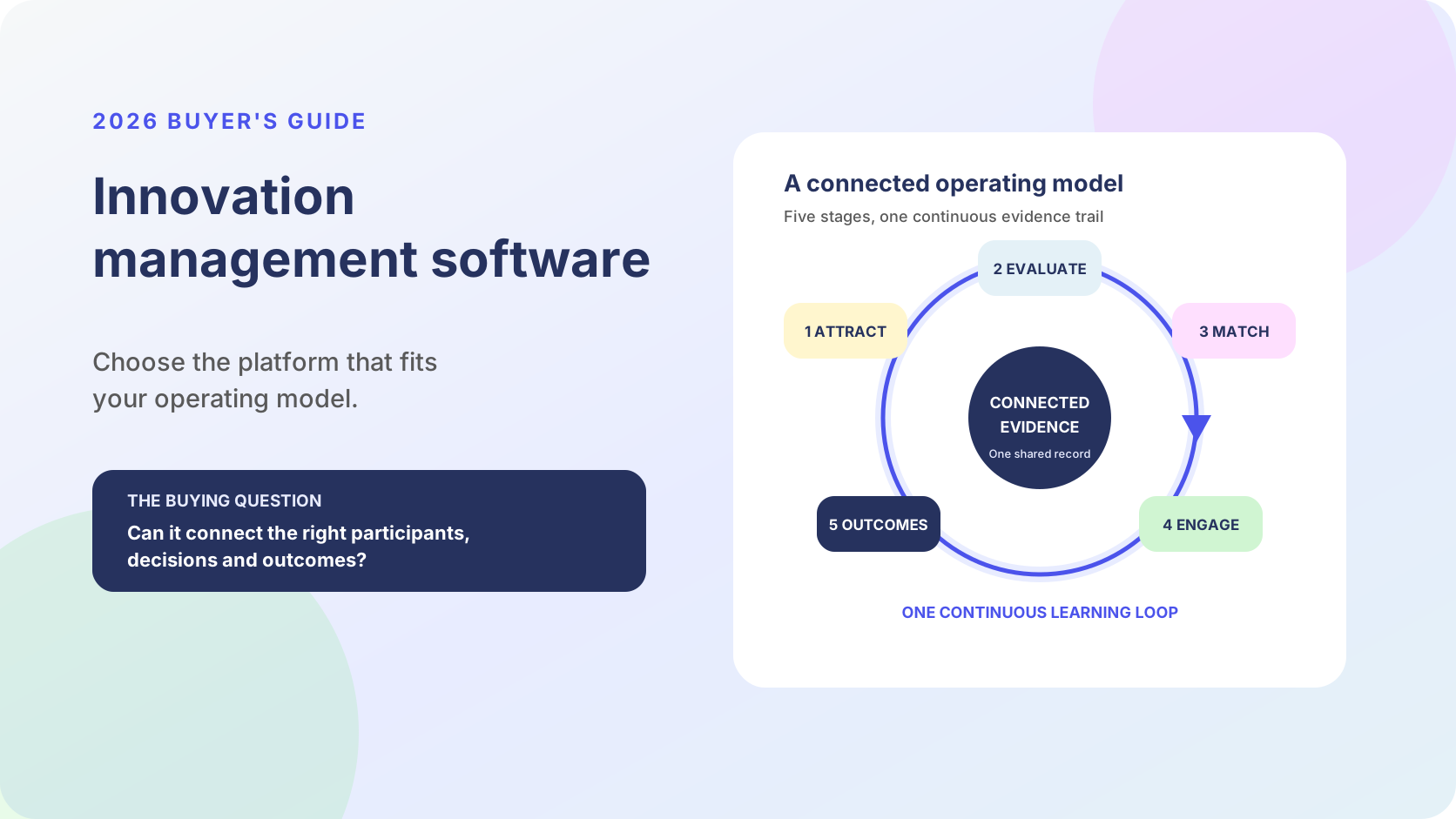
Attract covers the front door: branded pages, forms, profiles, opportunities and targeted outreach. Evaluate covers eligibility, scorecards, reviewer assignments, comments, stages and approval. Match connects people and organizations based on relevant data. Engage and grow supports selected cohorts, partners and communities after the decision. Track outcomes creates the evidence needed to manage the current portfolio and improve the next program.
A connected platform for programs and ecosystems is most useful when several of these stages matter and when losing context between them creates risk, delay or duplicated work.
Nine capabilities to evaluate in innovation management software
A useful requirements list should describe the work your organization needs to perform, the evidence it must retain and the experience each stakeholder needs. The following capabilities cover the main buying decisions without assuming every organization needs every module.
1. Configurable intake and a credible front door
The platform should support the forms, fields, attachments, eligibility questions and conditional logic required by your programs. For external initiatives, the public experience matters too: applicants and partners should encounter a credible, accessible destination that reflects your brand and explains the opportunity clearly.
Ask whether one platform can support internal submissions, public applications and invitation-only workflows without forcing every user through the same journey.
2. Multi-stage workflow and evaluation
Most consequential innovation decisions need more than voting or a single score. Look for configurable stages, mandatory eligibility checks, weighted criteria, qualitative comments, different reviewer groups, moderation and a record of why an entry progressed.
The system should make the decision process visible without pretending that software owns the decision. Our innovation program management capabilities are designed around these structured, role-based workflows.
3. Role-based stakeholder experiences
Applicants, evaluators, business owners, mentors, experts and program administrators do not need the same information or actions. Enterprise innovation management software should let each group see the relevant dashboard, content, tasks, profiles and permissions.
This becomes especially important when several business units or partner organizations share one environment but must retain separate visibility and responsibilities.
4. Search, discovery and matching
Finding a relevant entry in a large portfolio requires structured data, filters and search. Connecting people or opportunities requires something more: a defined matching model that compares meaningful profile, capability, interest or program data.
Ask how the recommendation is calculated, which fields administrators control, whether the component scores can be inspected and how users act on a match. A ranked recommendation is decision support; it should not be presented as an unexplained automatic selection.
5. Program and portfolio visibility
Program teams need to see the status of individual applications or initiatives. Leaders need a portfolio view across programs, stages, business units and outcomes. Check whether dashboards reflect live workflow data and whether reporting can distinguish activity from progress.
A high submission count may show reach, but it does not prove implementation or value. The platform should let you connect participation and evaluation data with later milestones, outputs and outcome measures.
6. Ecosystem engagement after selection
Many platforms become quiet once a winner is announced. If your operating model continues into a cohort, pilot, partner network or member ecosystem, assess the post-selection experience with the same care as the application form.
Useful capabilities can include searchable profiles, assignments, resources, events, opportunities, messaging, tailored notifications and recommendations. An innovation ecosystem platform should make the network more useful over time, not simply store a directory of names.
7. Reporting, outcomes and audit trail
Innovation reporting should answer three different questions: What activity occurred? What decisions were made? What changed as a result? Look for timestamped workflow history, evaluator records, configurable dashboards, exports and a way to connect selected initiatives to subsequent evidence.
For regulated or public-sector programs, establish which actions must be auditable and how long records must be retained before procurement begins.
8. Integration, security and data governance
Innovation platforms hold commercially sensitive submissions, personal information and evaluation records. Enterprise buyers should assess role-based access, authentication, audit logging, encryption, hosting, data residency, retention, backups, incident processes and supplier security credentials.
Integration requirements should be specific. “Has an API” is not enough. Identify which records must move, in which direction, at what frequency and which system remains authoritative.
9. Configuration, implementation and ongoing support
Flexibility creates value only when the platform can be configured and governed sustainably. Ask who maps the workflow, who builds the forms and dashboards, how administrators are trained, what changes your team can make independently and how larger changes are delivered.
The best implementation model for your organization may be self-service, guided configuration or a managed partnership. Make that choice explicitly rather than discovering it after purchase.
Mark each requirement as essential now, likely within 12–24 months or unnecessary. This prevents a long feature list from outweighing the few capabilities that determine whether your program succeeds.
Where AI helps in innovation management and where people remain accountable
AI is most useful when it reduces repetitive work, improves access to relevant information or creates a consistent first pass for human review. It is least credible when a vendor treats an unexplained score as a substitute for governance.
Practical uses include drafting forms, helping applicants structure information, searching across program data, clustering or classifying entries, producing summaries, supporting eligibility review, comparing profiles semantically, recommending relevant people or opportunities and generating reports from live data.
Those capabilities do not remove the need to define criteria, inspect outputs, manage conflicts of interest or assign decision ownership. NIST's AI Risk Management Framework emphasizes documented roles and responsibilities, defined human-AI oversight and accountable leadership. The same principles are useful when AI supports innovation-program decisions.
When comparing AI innovation management software, ask vendors to demonstrate the full path from input to output. Which data is used? Which model or scoring method is involved? Can administrators control the compared fields or criteria? Can reviewers inspect the rationale? Is client data used for model training? Can the capability be disabled? What is logged?
Our AI for innovation capabilities support the lifecycle through form generation, applicant assistance, search, AI-assisted evaluation, semantic matchmaking, recommendations and data intelligence. Human reviewers remain responsible for consequential decisions.
A practical innovation management software buyer scorecard
Use the following questions during discovery and demonstrations. Require evidence in the product rather than accepting a yes-or-no response.
- Which program types must the platform support now and later? List the real workflows: internal ideas, external challenges, accelerators, supplier programs, research networks or portfolios.
- Who participates, and what does each group need to see or do? Map applicants, contributors, evaluators, sponsors, mentors, experts, partners and administrators.
- Where does the process begin and end? Decide whether you need intake only, selection, pilots, portfolio tracking, ongoing engagement or the full journey.
- How are decisions made? Specify criteria, stages, reviewer groups, moderation, conflicts, approval gates and the evidence that must be retained.
- What must remain connected after selection? Consider assignments, milestones, resources, events, content, communication, partner profiles and outcome data.
- Which data must be searchable or matched? Define the profile fields, opportunity data, filters and semantic relationships that create useful discovery.
- Which reports support operations, governance and leadership? Separate day-to-day pipeline views from audit records and outcome reporting.
- What are the security and integration requirements? Name the identity providers, authoritative systems, data regions, retention rules and control evidence involved.
- Where may AI assist, and who reviews its output? Document the human-AI boundary and the questions vendors must answer about data, models, transparency and control.
- How will the platform be implemented and governed? Establish ownership, configuration responsibilities, training, support and the change process.
- What evidence will prove value? Choose measures connected to decisions, cycle time, participation quality, progression, implementation and outcomes.
Score each question against three dimensions: current fit, evidence demonstrated and future adaptability. A platform should not receive full credit because a capability appears on a roadmap or requires unscoped custom development.
Implementation and total cost: what to evaluate beyond the license
The cost of innovation management software usually includes more than the subscription. A meaningful comparison should consider implementation, configuration, data migration, design, integrations, administrator training, support, change requests and the internal effort needed to operate the system.
Begin with one well-defined operating model. Document the user types, workflow stages, forms, permissions, evaluation logic, notifications, dashboards and reporting. Then identify what can be reused across future programs. Reusable templates and shared data structures often create more long-term value than launching every initiative as an isolated site.
Can the platform adapt to your process without turning every change into custom development?
Are the participant and administrator experiences clear enough to sustain use after launch?
Who maintains forms, stages, reviewers, communications, content and reports?
Can new programs reuse the same platform, profiles, security model and reporting foundation?
Do not select a broad platform solely because it promises future consolidation. Consolidation is valuable only when the platform genuinely supports the specialist workflows you would otherwise manage in separate tools.
Which level of innovation management platform do you need?
The right scope depends on program complexity and the cost of handoffs. Use the smallest platform that supports your operating model without creating predictable gaps.
| Scenario | Likely starting point | Consider a broader platform when... |
|---|---|---|
| One internal idea campaign | Focused idea management or a configured program workflow. | You need multiple campaigns, staged development, external participants or portfolio reporting. |
| External innovation challenge | An open innovation platform with branded applications and evaluation. | Internal challenge intake, proactive scouting, pilot governance or persistent partner engagement must stay connected. |
| Accelerator or incubator | Program management with applications, selection, cohorts, tasks and mentoring. | You run several cohorts, share mentors or investors, and need a lasting founder ecosystem. |
| Supplier or partner program | Structured intake, profiles, evaluation and opportunity matching. | The directory, challenges, recommendations, pilots and relationship history must form one reusable marketplace. |
| Enterprise innovation portfolio | A connected program and portfolio environment. | Multiple business units, stakeholder types and external ecosystems require shared governance with controlled visibility. |
A simple form and spreadsheet may be sufficient for a low-volume, low-risk process. The case for a dedicated platform becomes stronger as participant types, program volume, evaluation complexity, governance requirements and post-selection engagement increase.
Where Skipso fits
We position Skipso as the AI-powered platform for multi-stakeholder programs and ecosystems. Innovation management is one of the strongest applications of that model, particularly when an organization needs both structured selection and ongoing ecosystem activation.
Our platform brings together a branded front door, configurable program workflows, applications, multi-stage evaluation, role-based experiences, profiles and directories, AI-assisted matching, ecosystem engagement and reporting. Organizations can use the program-management and ecosystem layers independently or connect them as their operating model expands.
Skipso is a strong fit when you need to:
- run several innovation or startup programs in one environment;
- coordinate applicants, evaluators, experts, mentors, partners and internal owners;
- combine defensible selection with engagement after the decision;
- create a branded, role-based experience rather than a generic form;
- connect matchmaking, directories and opportunities to structured workflows; or
- maintain reporting and auditability across the program lifecycle.
A simple internal suggestion box, one basic form or a purely transactional marketplace may not require this breadth. The purpose of a platform assessment is to establish that boundary honestly.
Frequently asked questions
What is the difference between innovation management software and an innovation management platform?
The terms are often used interchangeably. “Software” describes the product category, while “platform” increasingly signals a broader system that connects several activities, participant types and data sets. Buyers should compare the actual workflow boundary rather than assuming the label guarantees particular capabilities.
Is idea management the same as innovation management?
No. Idea management focuses on collecting, discussing, evaluating and progressing ideas. Innovation management is broader and may also include external challenges, scouting, pilots, portfolios, ecosystems and outcome measurement. Idea management can be one capability within a larger innovation platform.
Can one platform support internal and external innovation programs?
Yes, if it supports separate user types, registration routes, permissions, branding, forms and workflows. Verify that internal and external participants can receive different experiences and that sensitive information remains appropriately controlled.
How should AI be used to evaluate ideas or applications?
AI can support classification, eligibility review, summaries, scoring assistance and comparisons against defined criteria. People should establish the criteria, inspect outputs, handle exceptions and remain accountable for final decisions. The platform should make its data use, controls and reasoning appropriately transparent.
What does innovation management software cost?
Pricing varies by modules, program volume, user model, implementation, support, integrations and enterprise requirements. Compare total operating cost rather than subscription price alone. Skipso publishes an overview of its current plans and pricing, with final scope based on the platform configuration required.
How long does implementation take?
Timing depends on workflow complexity, design, data migration, integrations, security review and stakeholder availability. A well-scoped initial program can be configured faster than a multi-program enterprise rollout. Require a delivery plan with clear inputs, owners, testing and acceptance criteria.
Which security capabilities should enterprise buyers assess?
Assess authentication, role-based permissions, audit logging, encryption, hosting, data residency, retention, backups, incident response, supplier assurance and applicable privacy obligations. The requirements should reflect the sensitivity of submissions and decision records in your programs.
Choose the operating model before the platform
The innovation management software market contains capable products with genuinely different strengths. The best choice is not automatically the broadest suite or the product with the most AI claims. It is the platform that supports your participants, preserves the logic behind decisions and carries valuable opportunities into execution and measurable outcomes.
Start by mapping where your process begins, who participates, how decisions are made and what must happen after selection. That operating model will tell you whether you need an idea-management tool, a specialist platform or a connected environment for programs and ecosystems.
Map your innovation operating model
Tell us what you are trying to run. We will help you translate the participants, workflow, evaluation, AI and ecosystem requirements into the right platform configuration.
Request a tailored demo


